In-Season Winter Wedding Flowers, Month by Month
December Wedding Flowers
December wedding flowers lean on amaryllis, berries and evergreens. Amaryllis gives you a very large, trumpet-shaped bloom on a tall, hollow stem, in white, red or striped. Hellebores, often called Christmas roses, come in from December in small numbers and bring soft greens, creams and plums. Paperwhites add a scent guests notice across the room, and ilex berries (sold as winterberry) and holly, both December stems, give you the red that reads as the holidays without a single ornament.
The winter greenery is at its best this month: cedar, fir and pine boughs, plus brunia. Ranunculus, anemones and tulips are already in good supply, and white garden roses, spray roses and calla lilies are available all month, as they are all year.
January Wedding Flowers
In January the core winter flowers are all in good supply: ranunculus, anemones and tulips, with hyacinths and the first Iceland poppies. White anemones, with their black centers, are a winter favorite, and ranunculus comes in white, blush and deep burgundy. Hellebores carry on through the rest of the winter season.

February Wedding Flowers
February has the most choice of the three. Sweet peas and hyacinths reach their strongest supply, Iceland poppies are still around, and hellebores are easier to find than they were in December, all alongside the ranunculus, anemones and tulips.
The catch is Valentine’s Day. Flower imports surge from mid-January to mid-February, and in a typical year the price of a dozen roses roughly doubles around February 14. If your wedding falls near the 14th and you want red, build the bouquet on red ranunculus or tulips and keep roses as an accent.
The Best Flowers for a Winter Wedding
These are the winter blooms we reach for most and what each one does in a design.
| Flower | What it brings | Where we use it |
|---|---|---|
| White garden roses | Full, layered heads that open slowly through the day | Bridal bouquets, centerpieces |
| White spray roses | Several small blooms on one stem | Filling out bouquets and low centerpieces |
| Ranunculus | Tightly layered petals in white, blush and burgundy | Bouquets, boutonnieres |
| Anemones | White petals around a black center | Bouquets, centerpieces |
| Calla lilies | Clean lines and a long vase life | Modern bouquets, tall arrangements |
| Tulips | Stems that keep curving after they are cut | Bouquets, low arrangements |
| Amaryllis | Very large blooms on tall stems | Ceremony pieces, tall arrangements |
| Hellebores | Muted, nodding flowers in green, cream and plum | Textured bouquets, centerpieces |
| Lisianthus | Rose-like layers that hold up out of water | Boutonnieres, corsages |
| Brunia, thistle, berries | Silver, blue and red texture | Winter bouquets, boutonnieres |
| Pine, cedar, eucalyptus | Volume, scent and structure | Arches, garlands, table runners |
Peonies and Dahlias in Winter
Peonies and dahlias are the two requests that are hardest to fill between December and February. Peonies sold in the US in winter come from Chile and New Zealand in December and from Israel later in the season, in limited varieties and at winter prices. Dahlias are a summer and fall flower, and in winter supply is limited at best. If you love the peony look, choose ranunculus, which is in season and gives you the same layered look on a smaller head.
Winter Bridal Bouquets
In winter a bouquet goes out into cold air between the car, the ceremony and the photographs, then spends hours in a warm, dry room. So we build a winter wedding bouquet on stems that cope with both, roses first, and give it sturdy texture around the edges. Three directions for a winter bridal bouquet:
- All-white bouquet. White garden roses, white ranunculus and white anemones, with silver brunia, dusty miller and seeded eucalyptus, finished with a velvet ribbon.
- Deep red bouquet. Burgundy roses, dark red ranunculus and hypericum berries, with cedar tucked in at the edges. It suits an evening ceremony and a December date.
- Textured, natural bouquet. Hellebores, cream tulips, blue thistle and a few sprigs of pine, gathered loosely and hand-tied.

For bridesmaids, we make smaller versions of the bridal bouquet in the same stems, so the group photos hang together.
Winter Wedding Color Palettes
Each of these three winter palettes fits a different kind of room. Pick one early because it shapes the rest of the decor, from the linens to the candles.
White and Silver
This is the white winter wonderland look: white blooms such as roses, anemones and paperwhites, with silver brunia and dusty miller. Bright white flowers look best in a room with pale walls. Plan plenty of candlelight with it because all-white flowers can read cold in evening photos without warm light around them.
Deep Reds and Plums
Burgundy roses, plum calla lilies and hellebores, with cedar and berries. This palette suits rooms with dark wood, brick or low light, and deep colors keep their richness under warm evening light, where pastels can wash out.
Soft Neutrals
Cream roses, blush tulips and white lisianthus, with eucalyptus and a few dried grasses. It’s the easiest palette for a restaurant or a loft, where the room comes as it is: cream and blush sit comfortably with wood, brick and white paint.
Boutonnieres, Ceremony and Reception Flowers
Boutonnieres and Corsages
Boutonnieres spend more time outdoors than any other piece, usually during photos in the cold. Small flowers on hardy stems last longest: spray rose buds, blue thistle, hypericum berries and a sprig of eucalyptus. Corsages for parents and grandparents can repeat the same mix so the family photos match.

Ceremony Arches and Chuppahs
For an arch or a chuppah, evergreens do most of the work. Cedar, pine and seeded eucalyptus build the base, so the flowers can be concentrated where the camera sees them: one generous cluster at the top or at the sides rather than blooms scattered evenly across the whole frame. White hydrangeas and amaryllis make good focal flowers against the green.
Winter daylight goes early, and in December it’s dark by late afternoon. For an evening ceremony, plan the lighting with the floral design: candles, string lights or crystal strands woven through the greenery.

For a large indoor ceremony, tall arrangements on columns at the entrance make the room feel finished the moment guests walk in, and they can move to the reception afterwards.

Reception Centerpieces
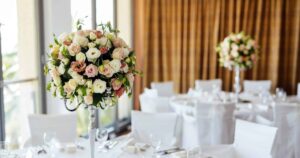
Low centerpieces keep conversation going across the table: white roses and anemones with pine and eucalyptus, surrounded by candles at different heights. In rooms with high ceilings, tall flower arrangements built on branches fill the space without blocking anyone’s view. The same stems carry into the smaller floral arrangements around the room, on the bar, the escort table and the cake table.
Ceremony flowers can be reused at the reception. An arch can become the backdrop for the head table, and aisle arrangements can go on the bar or the escort table. If you want to reuse pieces, tell us when you first send your wedding flowers request because it changes how they are built and moved.

Christmas and New Year’s Eve Weddings
A Christmas wedding comes with a head start: the venue is often decorated already, and the season brings its own colors. Ask the venue’s coordinator what will be up on your date, the tree, the garlands, the lights, and design the flowers to sit with it rather than compete.
Deep red and burgundy florals look richer than bright red. Pair them with cedar, pine and other winter foliage, plus white flowers, and keep the berries as an accent. Amaryllis, hellebores and ilex berries are all in season in December, so a holiday palette is easy to source.
For a New Year’s Eve wedding, the flowers come down after midnight, so check that your quote includes the late-night breakdown.

What Winter Does to the Cost of Wedding Flowers in NYC
How Your Date Affects the Price
The wholesale market and florists’ calendars are tightest in early fall and late spring. Outside the holiday weeks, a winter date avoids that squeeze, so the same budget usually buys more flowers. If your date is a Saturday in December, ask whether it counts as a peak date.
Why Winter Prices Depend on Where Flowers Are Grown
In winter, wedding flower prices follow the growers who supply the city, most of them in Colombia and Ecuador, not the weather in New York. Flowers with a steady winter supply, like roses, calla lilies and ranunculus, are the best value. Out-of-season requests cost the most, and so do red roses in the weeks before Valentine’s Day.
Using Greenery to Save on Flowers
Most winter wedding pieces start with greenery. Cedar, pine and eucalyptus add volume for less than flowers do. An arch built on evergreens needs fewer blooms, and a garland down the middle of a long table can stand in for several centerpieces.
How to Keep Winter Wedding Flowers Affordable
- Choose a weekday or a date outside the holiday weeks.
- Build on roses, spray roses and evergreens, and save the special stems for the bridal bouquet.
- Reuse the ceremony flowers at the reception.
For the per-item ranges in the city, see what wedding flowers cost in NYC.
Keeping Winter Flowers Fresh on the Wedding Day
Winter is hard on flowers in two ways: cold air outside and dry heat inside.
- Keep them out of freezing air. A few minutes outdoors for photos is fine. Never leave a bouquet in a cold car or on a doorstep. Frozen petals collapse once they warm up.
- Keep them away from heat. Radiators, heating vents and candles dry petals out. Ask the venue where the vents are before the centerpieces go down.
- Keep bouquets in water until the last moment. Bouquets should go back in water between the ceremony, the photos and dinner. Boutonnieres stay on all day, so keep them in their box somewhere cool until they’re pinned on.
- Avoid fast swings between cold and warm. Coming straight in from icy air to a hot room leaves condensation on the petals.
Planning Your Winter Wedding Flowers With Us
To give you a real number for a winter wedding, we need five things: your date, the venue, the guest count and table count, a budget range, and two or three pictures you like. Send them through the quote form on our NYC wedding flowers page and we’ll come back to you with what your date and budget can do. If you’d rather start by looking, our wedding and event arrangements show the style we work in.
Our flower shop is at 28-02 Steinway Street in Astoria, and we deliver wedding flowers across Queens, Brooklyn, Manhattan, the Bronx and Nassau County. If your date is in October or November, our guide to fall wedding flowers covers that season, and our month-by-month guide to choosing blooms that match your date covers the rest of the year.

Winter Wedding Flowers FAQ
What are the best flowers for a winter wedding?
Build on flowers that are in season: ranunculus, anemones, amaryllis, hellebores and tulips, with white roses and calla lilies, which are reliable all winter. Pine, cedar, eucalyptus, brunia and berries add texture and hold up well in the cold.
What wedding flowers are in season in December?
Amaryllis, paperwhites, ilex berries and holly are at their best in December, along with evergreens such as cedar, fir and pine, and the first hellebores appear. Ranunculus, anemones, tulips, roses and calla lilies are all available too.
Are winter wedding flowers cheaper?
Often. Winter is off-peak for weddings outside the holidays, and the flowers in season are in steady supply. The exceptions are red roses in the weeks before Valentine’s Day and out-of-season requests like peonies.
Can I have peonies at a winter wedding?
Yes, but in winter they are flown in from Chile, New Zealand or Israel, in limited varieties and at a high price. Ranunculus gives a similar layered look and is in season.
How do you keep flowers from freezing at an outdoor winter ceremony?
Keep them inside and in water until the last moment, choose sturdy stems such as roses, thistle, berries and evergreens, and keep the time outdoors to the ceremony and the photos.
When should you book a florist for a winter wedding?
Six to twelve months ahead is safe for a Saturday. Weekday and off-peak dates can often be booked later, but if your date falls in a holiday week, ask early.